
Maybe we are not Ashanti. Maybe our ancestors were from Nigeria and elsewhere, not Ghana.
The origins of the enslaved people who were the ancestors of most Black Jamaicans are sometimes debated. Some Africans tell me I can’t be so sure we have Ashanti or Akan ancestry since slave ports in Ghana were a gateway for the enslaved from all over the continent. In fact, if you closely observe a Jamaican, generally bold, ambitious, and extremely self-assured, you might certainly be inclined to liken us to Nigerians rather than the more humble and gentle Ghanaian people.
I am no history expert, but in my mind, so many elements of our Jamaican culture support the Ghana link asserted by historians. Our language, our music and dance, our food, and certain religious practices are among the many areas of our lives where Akan/Ashanti retention is evident. In this post, I want to explore one very specific legacy: Adinkra symbols.
You are probably wondering what those are and why they are relevant to a conversation about cultural retention in Jamaica. For starters, Adinkra symbols from Ghana represent concepts or wise sayings and are widely used to decorate fabrics and pottery, as well as in architectural features. Here is a link to the symbols and their meanings.
I was quite surprised when I discovered how widely used these symbols are in Jamaica without our even realising it. They have become almost indispensable in the grillwork of our homes. Take a look at the symbols below and tell me they are not familiar. More importantly, notice the inspiring and pithy meanings attached.

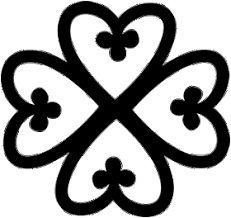
I am so happy that the developers saw it fit to embed these symbols in our story of freedom at Emancipation Park. If you’ve walked around the Park, you might have noticed a number of Adinkra symbols on benches and the fencing, etc. Of course, as you would have realised by now, you don’t need to visit Emancipation Park to see such symbols. Simply walk around your neighbourhood and look at the grillwork; they are everywhere. My own grillwork at home has some variation of the ram’s horns symbol, which signifies strength (physical, emotional, and spiritual), humility, wisdom, and learning. It was a random choice. It makes me wonder, though, how many of us, in deciding on designs for our grills, have any idea of the origins of these designs and the words of wisdom we are embedding in our homes.
I experience a sense of wonder when I think that over two hundred years after the slave trade ended, these messages from our Ashanti ancestors continue to teach us, inspire us, and guide our paths. If only we knew that.
SUMMARY AND WRAP-UP
Adinkra symbols came to Jamaica by way of our Ashanti ancestors and continue to adorn our homes with their powerful and wise messages. The symbol of Sankofa, for example, urges us to consider the past as a guide in planning the future. Take a walk through your community or Emancipation Park and look out for the Adinkra symbols in grillwork or elsewhere. I bet you’ll be surprised at just how pervasive they are.
I am aware that these symbols are also used in grillwork in Barbados, but I’d love to know if they are also present in other Caribbean islands and in what formats. Let me also know in the comments if you had any idea of the origins and meanings of these very popular symbols.


 In Our Neighbourhood
Leave a comment