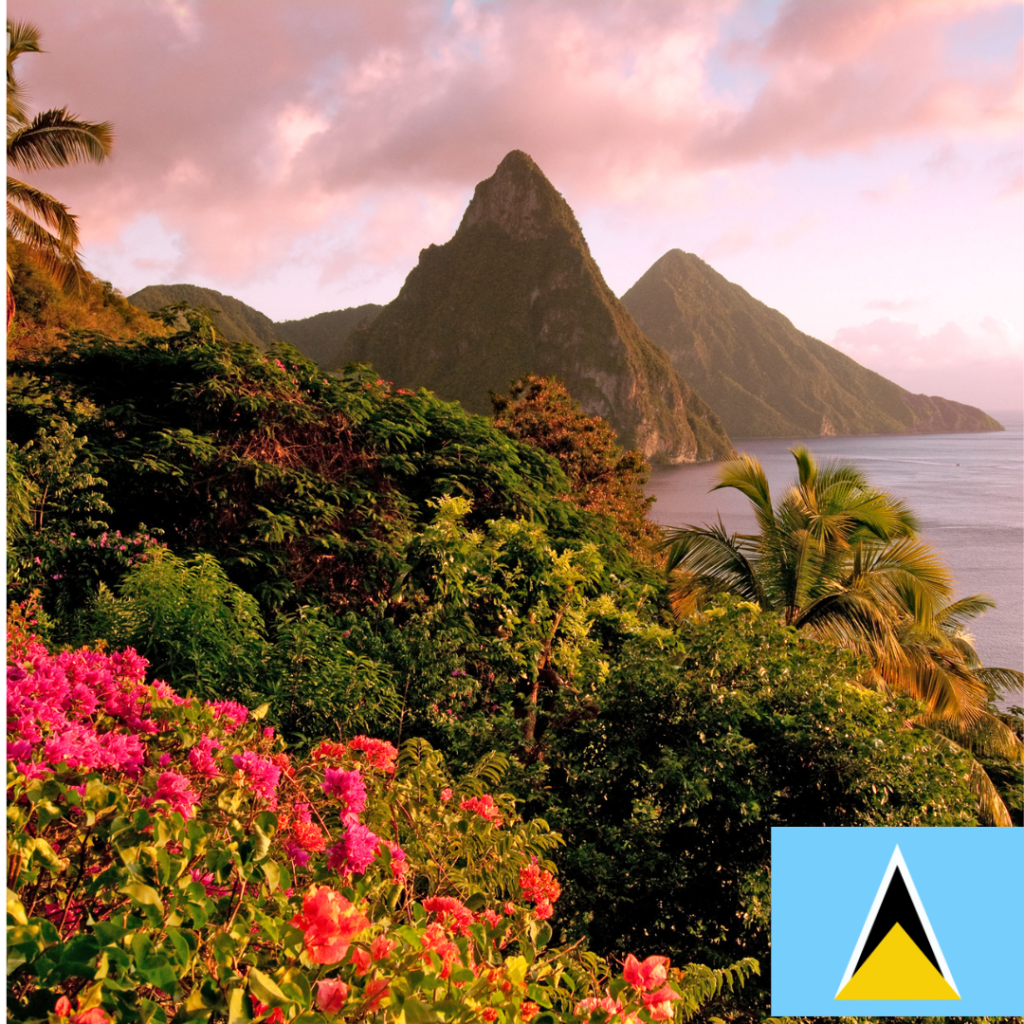
St. Lucia has been in the news a lot recently, thanks to the gold medal win by St. Lucian athlete Julien Alfred in the 100m finals at the just-concluded 2024 Paris Olympics. This was St. Lucia’s first medal ever in the Olympics, and it was a gold medal and an undeniable source of great pride for St. Lucians.
I bet many people wondered what a St. Lucia was when they heard the news. Others probably thought it had something to do with Jamaica. Were you one of them? Unfortunately, this is a source of ongoing angst for most small islands: unknown or reduced to white sand beaches, and seen as generally monolithic and mediocre. The beaches of St. Lucia are quite impressive, of course, but St. Lucia is far more than the typical Caribbean imagery. This is a place where history, culture, and nature collide in the most surprising ways.
St. Lucia was my first overseas trips and remains one of my favourite Caribbean islands. It is stunning, with trance-inducing cliff views of the ocean and sky. The people are also laid back and warm and they have a little cassava bread spot on the east coast, which has the best variation on this Caribbean staple that I have tasted. That’s not all that makes St. Lucia special, however, so here are five facts about St. Lucia that are not well known, but that give you a better sense of the island.
The Most Nobel Laureates Per Capita
St. Lucia has given the world two whole Nobel Laureates in a country of under 200,000 people! Sir Arthur Lewis, economics genius, was awarded the Nobel Prize in Economics in 1979 for his pioneering work in economic development research, with particular attention to the problems of developing countries. Sir Derek Walcott, exquisite poet and playwright, was awarded the Nobel Prize in Literature in 1992 “for a poetic oeuvre of great luminosity, sustained by a historical vision, the outcome of a multicultural commitment” (Nobel Foundation). The Nobel Prize awards the zenith of human achievement and for a small island from the Caribbean, this honour is a noble feat.
The World’s Only Drive-in Volcano
Like most countries of the Eastern Caribbean, St. Lucia is a volcanic island. That has given rise to a myriad of geological features of great interest, including sulphur springs and a volcanic crater in the town of Soufrière that you can drive to. Exploring the volcanic crater was fascinating. If you appreciate natural wonders but prefer a less physically demanding experience, this is an ideal option for witnessing a marvel of nature up close and personal.
The Hybrid French and British Influence
This is no monolithic island. St. Lucia is in large part the love child of France and Britain, from a colonial perspective, and it was quite the custody battle. St. Lucia became a battleground for the French and British Empires during the colonial period and frequently switched hands back and forth among the two, after first being colonised by the French. What has resulted is a melting pot of cultures. While officially an English-speaking country with strong remnants of Britain in its cuisine, and legal and education systems, etc., the country is replete with French names. Gros Islet, Vieux Fort, Soufrière…The list is interminable. St. Lucians also speak a French-based Creole language, which is uncommon among English-speaking countries in the Caribbean. The Kwéyol is also influenced by African languages, naturally.
A Fascinating Indigenous Heritage
Arawaks, likely migrating from South America, were thought to be among the first inhabitants of the island, naming it “Louanalao” or “ Island of the Iguanas”, when they arrived in 200 AD. They would later be replaced by the Kalinago (Caribs) who called it “Hewanorra”. What is interesting is that Kalinago culture continues to influence St. Lucian culture even today. In essence, the demographics and cultural influences in St. Lucia are far too diverse to warrant a label of homogeneity.
A Declared World Heritage Site
St. Lucia’s Pitons were inscribed on the World Heritage List by UNESCO, a list reserved for sites around the world considered to be of “outstanding value to humanity”. That’s right: they are of value not just to the host country as a whole, but also to people across the world. If you see them in person, you will understand why. These are collectively one of the most striking mountainous formations in the Caribbean region and the world, as the twin peaks rise dramatically from the St. Lucian rainforest in an ultimate testament to nature’s artistry. Moreover, the Pitons Management Area has important geological value and is home to a wide diversity of terrestrial flora and fauna, as well as marine life.
Summary
It is clear that you can’t judge a book by its cover because there is far more to St. Lucia than meets the eye, with its natural heritage recognised by UNESCO, the only drive-in volcano worldwide, a fascinating British, French, and Indigenous (in addition to African, etc.) heritage, and two Nobel Laureates. St. Lucia is, without a doubt, a tiny island with a big personality. Now you know.

 In Our Neighbourhood
Leave a comment